
The rules of local discovery have fundamentally shifted. If you run a service-based business, a clinic, a retail shop, or a local firm, you have likely noticed that your customers are no longer just scrolling through traditional search engine results pages. Instead, they are asking conversational AI tools, voice assistants, and Google AI Overviews to give them direct recommendations.
When a prospective client asks, "What is the highest-rated emergency plumber near me available on a Sunday morning?" search engines do not just give them a list of ten blue links. They provide a synthesized, definitive answer, often naming just one or two standout businesses.
As an in-house copywriter at Big Reach PR & Marketing, I have spoken with dozens of small and medium-sized business owners who feel bewildered by this transition. They ask me whether traditional SEO is dead. The short answer is no. But if you are only optimizing for traditional rankings while ignoring the new era of AI search, your business is invisible where it matters most.
Let's break down the exact differences between Answer Engine Optimization (AEO) and traditional SEO, and explore how you must adapt your Google Business Profile (GBP) for 2026.
1. Core Differences: AEO vs. Traditional SEO
To win in modern digital marketing, you must understand how these two strategies complement one another. Think of traditional SEO as your foundation, and Answer Engine Optimization as the skyscraper built on top of it.
Traditional Local SEO
Traditional SEO focuses on optimizing your web pages, local citations, and Google Business Profile to rank within Google's traditional map pack and organic results.
- Primary Goal: Drive traffic, website clicks, phone calls, and physical directions.
- Key Metrics: Keyword rank positions, organic sessions, click-through rates (CTR), and map pack visibility.
- Typical Outputs: Service landing pages, local citations, consistent NAP (Name, Address, Phone) data, and review volume.
Answer Engine Optimization (AEO)
AEO focuses on structuring your business data so that conversational AI engines, such as ChatGPT, Perplexity, Gemini, and Google AI Overviews, can easily parse, trust, and cite your business as the direct answer.
- Primary Goal: Citation and inclusion in synthesized AI responses, rather than merely securing a click.
- Key Metrics: Brand mention frequency, AI answer share of voice, and direct engagement surges.
- Typical Outputs: Claim-dense descriptions, structured Q&A data, precise attribute lists, and factual entity profiles.
As search behavior evolves, you cannot succeed with just one. Traditional SEO earns you eligibility in the local marketplace. AEO ensures that AI systems select you when a customer asks a high-intent, hyper-specific question.
2. What This Means for Your Google Business Profile
Your Google Business Profile remains the single most important asset for local visibility. However, its role has expanded dramatically. It is no longer just a digital storefront for human searchers; it is a primary data feed for AI answer engines.

The Dual Role of GBP in 2026
When an AI model generates a local recommendation, it crawls structured databases and trusted entity profiles to verify facts before making a claim. Your Google Business Profile supplies those vital facts.
- Traditional Local Discovery: Signals like geographic proximity, review recency, category selection, and citation consistency still determine whether your profile appears in local map packs.
- AI Answer Extraction: Answer engines scan your services, attributes, business description, and owner-answered Q&As to extract verifiable facts. If your profile is vague or incomplete, AI models will pass over you in favor of a competitor with precise, structured data.
For example, if your MedSpa profile simply states "We offer skin treatments," an AI assistant cannot evaluate whether you provide "same-day acne consultations" or "medical-grade chemical peels." To win in AEO, your profile must read like a high-confidence, factual data source.
3. The Practical Playbook: Optimizing Your GBP for SEO and AEO
Implementing a dual strategy does not require overhauling your entire operation overnight. Instead, you can execute a step-by-step workflow that satisfies both traditional ranking algorithms and AI extraction models.
Step 1: Secure Your Traditional Local SEO Foundation
Before worrying about AI algorithms, ensure your core local presence is airtight:
- Maintain Absolute NAP Consistency: Your business name, address, and phone number must match identically across your website, GBP, and major industry directories.
- Select Precise Categories: Choose primary and secondary categories that directly reflect your most lucrative services. Avoid stuffing irrelevant categories.
- Drive Strategic Reviews: Encourage satisfied customers to mention specific services and attributes in their reviews (e.g., "fast emergency appointment," "family-friendly dentist"). These reviews act as powerful third-party validation for both human searchers and AI models.
Step 2: Add an AEO Layer to Your Profile
Make your Google Business Profile instantly understandable for AI engines by refining how you present information:
- Write Claim-Dense Business Descriptions: Replace generic marketing fluff with concrete facts. Instead of writing, "We are passionate about delivering top-tier legal representation," use: "Providing commercial litigation and contract law services in [City] with over 15 years of experience and rapid consultation response times."
- Fully Populate Services and Products: Break down every individual offering with clear, concise descriptions. If you run a salon, list specific treatments such as "balayage color correction" and "keratin smoothing treatments" rather than just "hair styling."
- Leverage GBP Q&A Proactively: Seed your own frequently asked questions with direct, one-to-three-sentence answers. Answer engines love extracting concise Q&A pairs directly into AI overviews.
- Publish Claim-Driven GBP Posts: Treat Google Posts as micro-updates that answer real customer questions (e.g., "Yes, we are open on Saturdays from 9 AM to 2 PM" or "We offer same-day emergency roof repairs across [City]").
4. Measuring Success Across Both Fronts
As marketing strategies evolve, so must your measurement framework. Relying solely on click-through rates will leave you blind to the benefits of AI citations.
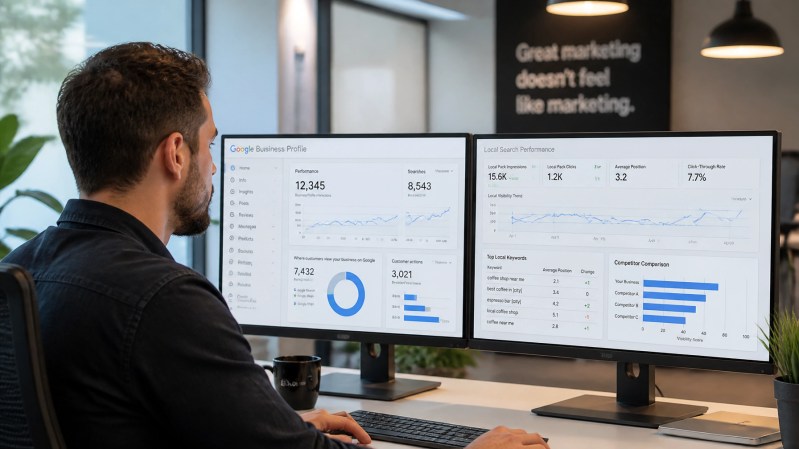
- For Traditional SEO: Track your map pack rankings, local discovery views, phone calls, and direction requests directly inside your Google Business Profile performance dashboard.
- For AEO: Monitor shifts in branded search volume, direct traffic spikes, and your visibility within AI-generated search tools for your core service keywords. When your business begins appearing consistently inside AI overviews and conversational recommendations, you will see a direct increase in high-intent inbound inquiries.
Conclusion
The evolution from traditional search to answer engines represents one of the most exciting shifts in digital marketing history. By treating traditional SEO as your entry ticket and Answer Engine Optimization as your competitive edge, you position your business to dominate both human searches and AI recommendations in 2026.

At Big Reach PR & Marketing, we help small and medium-sized businesses navigate these complex digital transitions with clarity and confidence. If you want to ensure your brand is not just found, but actively chosen by modern search engines and AI tools alike, reach out to our team today. Let's build a future-proof visibility strategy for your business.


